Prcanj stretches along the south shore of the bay, and many cars can be delivered to the Prcanj waterfront, and most accommodation has off-street parking spaces.
Popular rental cars in Prčanj
On a frontage this tight, a narrow city car earns its place over any wide body you would be folding the mirrors on.
Prcanj on the bay road west of Kotor
Collect a rental car at Prcanj and the inner bay road puts Kotor old town 10 minutes east and Tivat 15 minutes west. With a car, the full inner Bay of Kotor runs east to Kotor, on past Perast and Risan, then along the northern shore to Herceg Novi. The natural way in is to rent a car at Tivat Airport, 10 km away, and run the bay road through Prcanj to Kotor. The road follows the water's edge for most of its length, with the Vrmac ridge rising steeply above and views across the bay toward the Verige strait. In summer it carries traffic between 10:00 and 18:00, so early morning and evening drives run significantly faster.
The village of sea captains
Prcanj is a small settlement on the southern shore of the Bay of Kotor, on the bay road that runs between Kotor and Tivat. Its reputation rests on a specific and verifiable piece of maritime history. Between the 17th and 19th centuries, the village produced 172 ship captains, a figure drawn from church records and Venetian-era maritime registers that tracked the licensed sea captains of the bay. For a settlement that has never held more than a few hundred households, the number is extraordinary. By the late 18th century, Prcanj was home port to 98 ocean-going vessels, making it one of the most significant merchant fleets in the eastern Adriatic. The families behind that fleet (among them the Luković, Gjurović, Sbutega, Lazzari, Mihnić, and Raffaeli families) were the same ones whose stone palaces now line the waterfront in an almost unbroken row of Baroque facades.
The village sits on the Tivat side of the bay, facing north across the water toward the narrowing Verige strait. Behind the houses the ground rises steeply toward the Vrmac ridge, leaving very little flat land, and the village is essentially one street wide, strung along the bay shore. This geography meant that anyone of ambition here went to sea, and the wealth they brought back is still visible in the stonework. Prcanj itself is walkable end to end in 15 minutes, while a rental car is the tool for the wider Bay of Kotor drive, connecting the village to Kotor, Orahovac, and the rest of the inner bay shore.
The Tripković palace and the waterfront architecture
The most prominent of the captain's palaces is the Tripković palace, located at the western end of the Prcanj waterfront. The Tripković family owned 18 ships across several generations and produced over 80 sailors, the majority of whom held captain's rank. The palace is an 18th-century Baroque building with ornate stone detailing, now partially ruined but still gives the waterfront its grandest stretch. Elsewhere along the promenade, a series of smaller palaces and merchant houses maintain the same Venetian-influenced stonework, with heavy lintels, arched ground-floor loggie, and coats of arms carved above entrance doors. Several of these buildings are now privately inhabited and not open to visitors, but the exteriors are visible from the waterfront path. The overall impression of the village as a whole is of a place that was wealthy three centuries ago and has since settled into something quieter, without losing the physical evidence of that wealth.
The Church of the Birth of the Lord
The Church of the Birth of the Lord (Crkva Рођења Господњег) is the most prominent landmark in Prcanj and the largest religious building on the southern shore of the bay. The Baroque facade, designed by the Venetian architect Bernardino Maccaruzzi, faces the water from a low promontory at the centre of the village. Construction began in 1789, funded largely by the village's wealthy sea captains, but the church was not finished until 1909, a span of 120 years that reflects both the ambition of the project and the long interruption between 1807 and 1867 when work effectively stopped. The final completion in 1909, well after the era of Venetian maritime wealth had ended, gives the church an unusual biographical quality, built by the captains' money but finished by their descendants in a different world.
The interior is more remarkable than the austere exterior suggests. The church treasury holds works attributed to Giovanni Battista Piazzetta, Giovanni Battista Tiepolo, and Antonio Balestra, significant names for a village of this size, brought here by captains who moved in the same trading world as the Venetian art market. The church also holds the flag "Merito Navale," presented by the Austrian emperor to Ivo Vizin of Prcanj in 1859 in recognition of his becoming the first seafarer to circumnavigate the globe under the Austrian flag. The ex-voto collection (votive paintings donated by mariners and their families recording rescues at sea and dangerous voyages survived) is considered one of the largest maritime votive collections of its style in the world. The church is open at irregular hours, and the most reliable access is around the Sunday morning service.
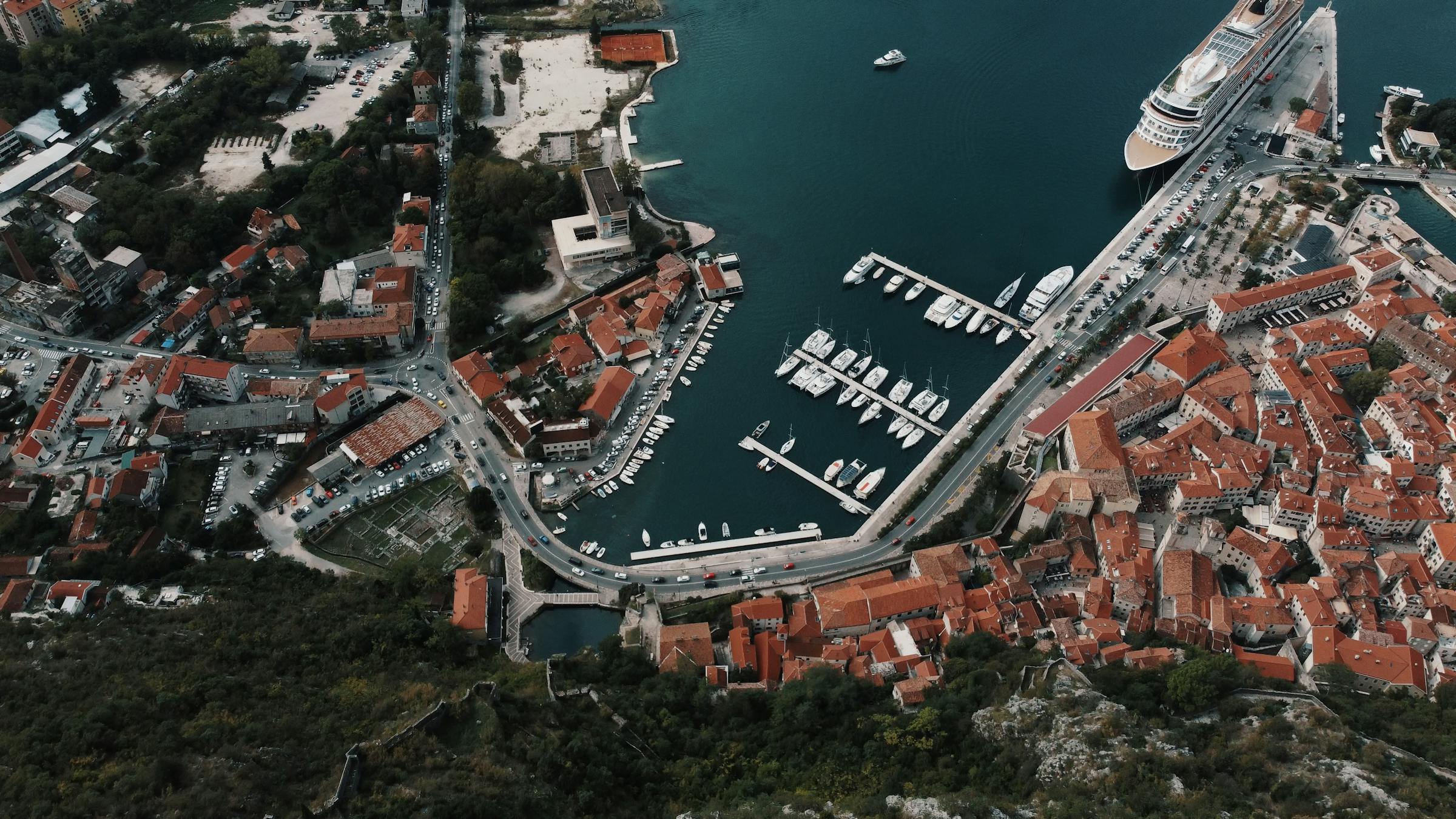
See current rates and availability for delivery along the Prčanj waterfront.
Free cancellation on most rates · waterfront delivery
The promenade and the water's edge
Prcanj has a coastal promenade that runs the length of the village along the bay road, between the stone houses and the water's edge. The village does not have a sand or pebble beach in the conventional sense, as the shore is rocky, with stone steps cut into the waterline at various points for swimmers to enter the bay. The water is clear and the bay here is calm, and the inner bay sees very little swell, while the Prcanj waterfront faces toward the Verige strait rather than any open water. A few cafes occupy the ground floors of the waterfront houses and put tables outside in summer. Local fishing boats moor at the small landing stages along the promenade, and the occasional passenger ferry on the Kotor-Tivat route passes close to the Prcanj shore. The promenade walk from one end of the village to the other takes about 15 minutes at a leisurely pace. Prcanj works well as a stop on the bay road rather than a base, and a rental car lets you park, walk the waterfront, and move on.
The Vrmac tunnel alternative
Between Prcanj and Kotor there is an inland alternative, the Vrmac tunnel, which bores through the ridge at 1,637 metres in length. The tunnel was partially opened in 1991 but only brought up to full European safety standards in 2007, after reconstruction work by the Austrian firm Strabag that added modern lighting, ventilation, and emergency systems. The tunnel is toll-free and cuts travel time between the Tivat side of the bay and Kotor significantly compared to the bay road in summer traffic. Most visitors use the bay road on the first drive (for the views) and the tunnel when time matters. Renting a car at Tivat Airport makes the full Tivat, Prcanj, Kotor inner Bay of Kotor drive the natural way to spend a day on this side of the water. From Prcanj going east along the bay road, Orahovac is 4 km and Risan is around 18 km, both on the continuing road that rounds the head of the inner bay.
Common routes from Prčanj
Kotor old town along the bay road (short hop)
Around 10 minutes east on the shore road reaches Kotor old town. The route follows the water's edge with the Vrmac ridge above and views across the bay toward the Verige strait.
Tivat and Porto Montenegro via Vrmac tunnel (15 minutes)
The Vrmac tunnel, 1,637 metres long and toll-free, bores through the ridge to Tivat in around 15 minutes, cutting summer traffic on the bay road. Tivat Airport is 10 km from Prčanj on the same route.
Perast and Our Lady of the Rocks (half day)
East along the bay road through Kotor and around the inner shore reaches Perast and the boat jetty for Our Lady of the Rocks. A natural extension of the inner-bay drive.
Orahovac and Risan at the head of the bay (half day)
Orahovac is 4 km east along the bay road, with Risan and its Roman floor mosaics 18 km further on at the head of the inner bay. The road rounds the head of the bay on a continuous shoreline route.
Insurance on the narrow bay frontage
Prčanj lines the bay road that links Kotor to Tivat without the mountain route, and it is one of the narrowest waterfront stretches in the bay, with houses and walls hard against the carriageway. Folding the mirrors and taking the passing places slowly is the local technique, and the realistic claim here is a mirror or wing brushed against stone, not a collision.
Edge-of-car damage can sit awkwardly within standard CDW, so check the cover for tight-lane scrapes before driving the Prčanj frontage.
When does Prčanj make sense as your base?
Prčanj appeals to anyone drawn to the bay's seafaring history wanting a foot in two towns, where captains' houses line the waterfront, the shore road threads through the village, and both neighbours are minutes away. The walled streets of Kotor sit just north along the water, and the airport and marina at Tivat lie a short drive over the headland to the south, with the rental covering both in an afternoon.
Car hire questions for Prcanj
The Kotor-to-Tivat shore road is the first thing to come up about Prčanj. It hugs the water so closely past this old maritime village that drivers ask how to handle the narrow frontage, where the passing places are, and which end of town to aim for when parking.
Is crypto accepted for Montenegro car rental payment?
Yes, crypto payment for the rental is accepted on a subset of the fleet. Crypto is also accepted as deposit payment on a similar selection. Use the payment filter when searching to see only listings that accept crypto.
What fuel level do I need to return a Montenegro rental car with?
The car is supplied with a certain fuel level agreed at pickup, and you return it at the same level. Suppliers note the level on the rental agreement. Filling stations for both diesel and petrol are easy to find nationwide.
Do I need an account to book a Montenegro rental car?
No. Bookings can be made directly from the booking flow using your name, email, and contact details. No account creation is required, and no credit card is needed to confirm the booking.
How far is Prcanj from Kotor Old Town?
Prcanj is about 3 km from Kotor's South Gate, roughly a 5-minute drive along the bay road. It is one of the closest bay villages to Kotor and makes a quiet alternative to staying in town.
Is there a car rental pickup point in Prcanj?
Yes, Prcanj is listed as a pickup location. The supplier will confirm the specific handover point by email; handovers typically take place at a nearby car park or accessible spot in the village.
What can I reach easily from Prcanj with a rental car?
Kotor is 3 km and 5 minutes away. Tivat is around 15 km via the tunnel, Perast is roughly 17 km along the bay road, and Budva is about 35 km. The central bay position makes Prcanj a good starting point for day trips in any direction.
A calm stretch of bay waterfront with Kotor a short drive round.
Handover on the bay road