Reževići pickups deliver to the monastery approach road and Perazica Do coast strip, and the fleet here is smaller, so booking a week ahead in July and August secures your category.
Popular rental cars in Reževići
The paved coast road takes a compact fine, but the rough tracks to the coves and up to the monastery want a 4x4.
Car access on the Paštrovska Rivijera
Collect a rental car at Reževići and the monastery approach road and the cove tracks off the coast are within minutes of pickup. Renting a car here is the only practical way to reach the monastery and the Perazica Do coves, as there is no bus stop at the monastery turning and the coast road has no footpath. Tivat Airport is 28 km north along the Adriatic Highway, roughly 35 minutes through Budva in light traffic, and if you arrive inland you can rent a car at Podgorica Airport, around 80 km away via the Sozina tunnel. The access to the Reževići area is signed off the coast road between the Pržno fork and the Sveti Stefan turning, and the monastery road is marked with a small roadside sign and accessible to ordinary cars for most of the year.
A car also makes it practical to move between the individual coves during the day rather than committing to one spot, and to run the short drives south to Sveti Stefan and Petrovac or north to Pržno and Budva as part of the same stay.
The Paštrovska Rivijera headland
Reževići is not a resort. It is a small settlement on the Paštrovska Rivijera, the stretch of coast between Pržno and Petrovac that takes its name from the Paštrovići clan, one of the most significant tribal confederations in medieval and early modern Montenegro. The headland between Pržno and Sveti Stefan is where the coast road bends inland briefly, and a side track drops to the water and a row of small coves beneath pine and olive trees. The swimming here is clear and the coves are largely unbuilt, which keeps the character closer to the pre-development Riviera than to either Budva or Petrovac. The Paštrovići were unusual among the Montenegrin tribes in that they operated under Venetian suzerainty from 1423 until the fall of the Republic in 1797, maintaining a degree of self-governance through their own assembly (the Paštrovska zborna) that met regularly at a handful of fixed locations along this coastline, including at the Reževići Monastery itself.
The coastline here was shaped by that long Venetian period. Stone buildings on the ridge above the sea, small harbours cut into the rock, and the monastery complexes that served both as religious centres and as meeting halls for the clan's governance are the lasting physical marks of the Paštrovići. The stretch between Pržno and Sveti Stefan has escaped the denser development that came to Budva and Bečići to the north, and the landscape retains pockets of old woodland and farmland between the scattered houses rather than a continuous built strip.
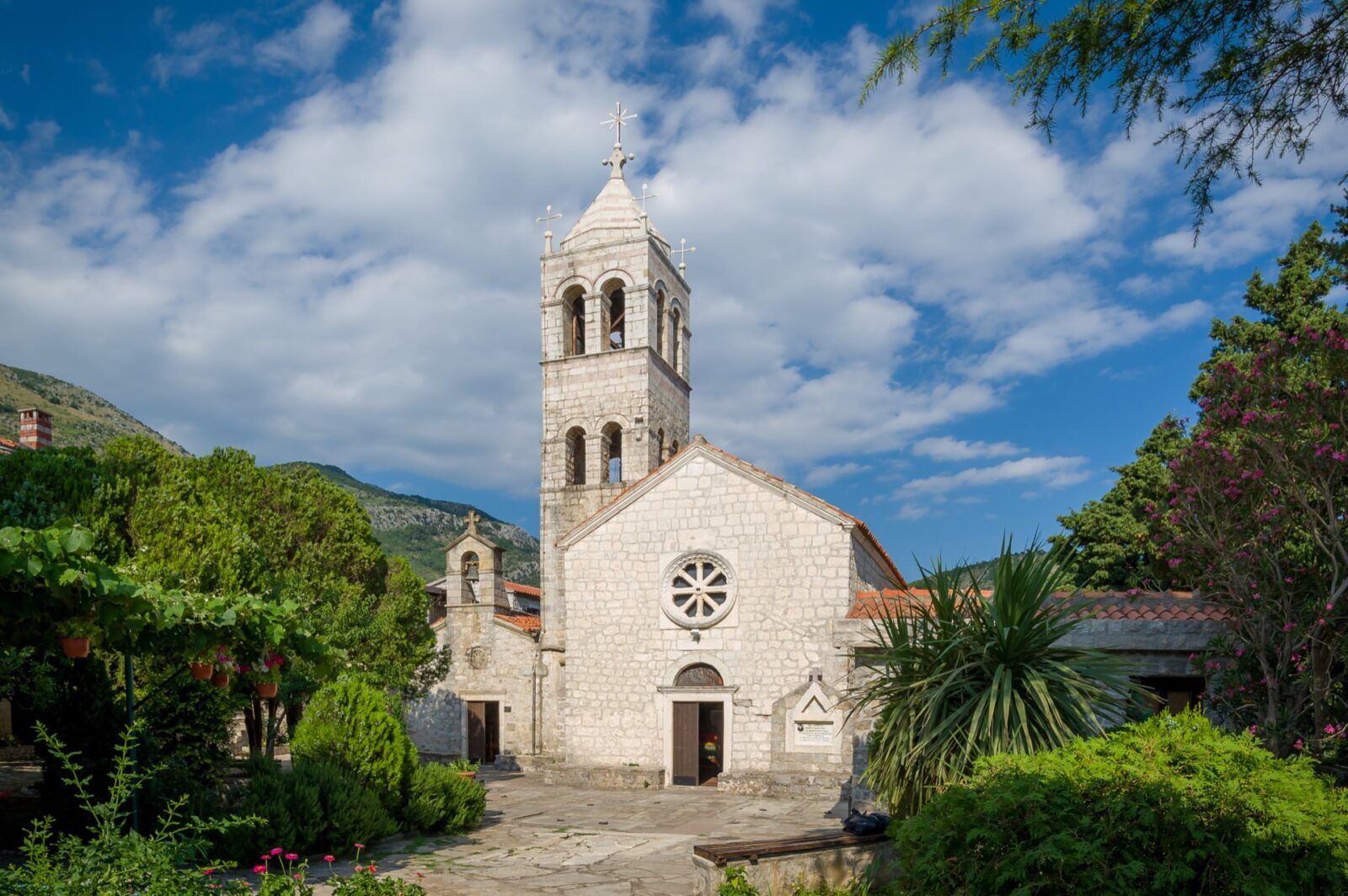
Reževići Monastery, history and what survives
The monastery on the ridge above the coast is the most substantial reason to make the detour to this stretch. Reževići Monastery is a walled Orthodox compound whose origins are traditionally traced to around 1223, when Stefan the First-Crowned (Stefan Nemanjić) is said to have founded the Church of the Dormition of the Mother of God near a guesthouse on this site. Documented history becomes firmer in the 14th century, when the monastery is recorded as a gathering place for the Paštrovići assembly. In 1351 a second church, the Church of the Holy Trinity, was built on the same compound. The last chieftain elected by the Paštrovići assembly at this monastery was Stefan Štiljanović, and the tradition of holding elections and important tribal councils here continued until the dissolution of the Venetian system.
The monastery complex suffered twice from external attack. In the mid-15th century both churches and the guesthouse were plundered and burned by Ulcinj pirates, and the compound was abandoned for a period before reconstruction. In 1785 it was plundered again, this time by Mahmud Pasha Bushatli, with the library and treasury taken or destroyed. The frescoes visible inside the Church of the Dormition today date primarily from the early 17th century and are attributed to Strahinja of Budimlje, a painter responsible for fresco cycles in several Orthodox churches across the region during this period. Fragments of an earlier 18th-century fresco layer have also been identified. In 1833, Aleksije Lazović painted the icons for the Church of the Dormition's iconostasis. The compound today is a working monastic house, and the courtyard, shaded by a large walnut tree, is open to visitors during daylight hours. Photography is generally permitted in the courtyard but not inside the church itself.
See live rates and availability for delivery to the monastery road or the Perazica Do coast.
Free cancellation on most rates · delivery to the coast lane
Rocky coves and the coast walk
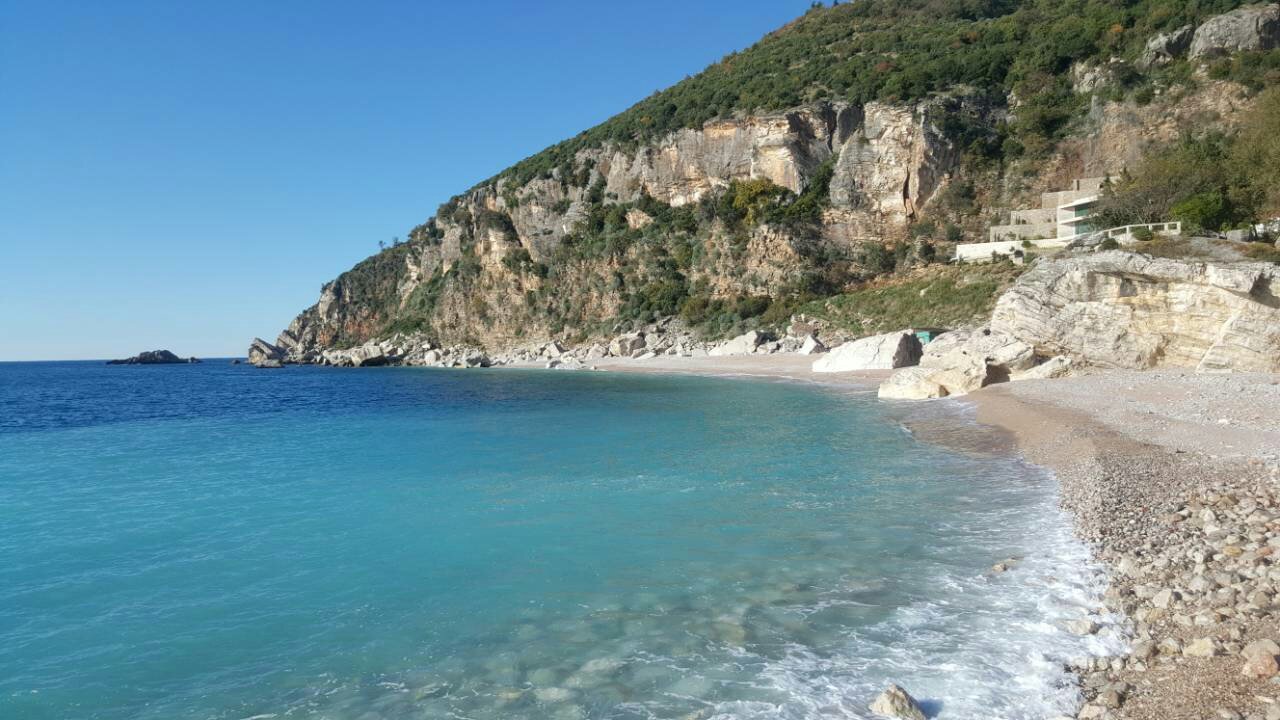
The coves beneath the Reževići headland are reached by the track that drops from the coast road near the monastery access road. The surface on the coves themselves is rock and pebble, and the entry into the water from the flat stone ledges is easy at most points. The coves are narrow and partly shaded by the pine cover on the slopes above, which keeps the atmosphere cooler than the open beaches at Sveti Stefan and Miločer further along. The water here is clear because the shallow bottom is largely rock rather than sand, and on a calm day the visibility is several metres.
A coastal path connects the coves back north toward Pržno and south toward the Miločer Park beach and the Sveti Stefan causeway. The Petrovac-to-Reževići trail, which runs through a pine forest with sections of shade and stone benches placed at intervals, is a well-maintained walk of around 5 km that attracts both locals and hotel guests from the surrounding area. At the peak of summer the coves fill with visitors from the nearby hotels at Sveti Stefan and Pržno, but outside July and August they are quiet. The Perazica Do area immediately below the monastery ridge is the section most often referenced as the the way to this stretch of coast, and it amounts to a cleared access point above the rocks rather than a beach in the conventional sense.
What makes this stretch different
The Paštrovska Rivijera between Pržno and Petrovac is among the last sections of the Montenegrin coast to have been developed in the manner of the Budva strip. The reasons are partly topographic, as the coast here alternates between limestone headlands and narrow coves with no continuous sand beach long enough to support a large hotel complex, and the road runs slightly inland in several places rather than along the water's edge. The result is a coastline where the open-access coves remain genuine options rather than extensions of hotel-managed territory. The Reževići area sits at the midpoint of this stretch, with the monastery as its anchor and the rocky coast as the draw for swimmers and walkers.
Seasonal patterns follow the broader Montenegrin coast. May and June offer warm days, warm-enough water from late May, and minimal crowds. July and August bring the full seasonal influx from Serbia, Bosnia, and increasingly from western Europe, and the coast road slows down. September is by general agreement the best month, when the water is at its warmest, the crowds have thinned, and the light on the limestone changes in the lower sun angle. After October, the area becomes very quiet. Most of the seasonal accommodation closes, while the monastery and the coves remain accessible.
The neighbours, Pržno and Sveti Stefan
Reževići sits between two of the more visited sections of the Budva Riviera. To the north, Pržno is roughly 2 km along the coast, a small fishing village with a sheltered bay, a handful of family-run restaurants, and a beach that is among the quieter options on this stretch. To the south, Sveti Stefan is around 3 km away, the iconic walled islet linked to the mainland by a narrow causeway. The headland viewpoint for the islet is on the coast road immediately north of the Aman resort access, and the public half of the causeway beach is free to enter. Between the two, Miločer Park is the planted royal garden estate behind the beach that once belonged to the Karađorđević dynasty and now operates as the beach and grounds associated with the Aman resort at Sveti Stefan. The park beach is ticketed for non-guests.
Accommodation in the area
There are no large hotels in Reževići itself. The accommodation is a mix of private villas, apartments in small family-run buildings, and a few rooms-to-let in the village above the coast road. The larger hotel inventory is at Sveti Stefan (the Aman resort) and Pržno (several smaller hotels and guesthouses), and many visitors base in Budva or Bečići and drive down. The spacing between villages on this stretch means there is still woodland and farmland between properties rather than the continuous built strip found further north between Budva and Bečići. For visitors without a car, the stretch between Pržno and Sveti Stefan is theoretically walkable along the coastal path, but the coast road itself has no footpath and the distances between facilities are large enough to make car rental the practical option for anything beyond a single-beach day. Most visitors who rent a car for the Paštrovska Rivijera use it to cover the monastery, Perazica Do, Sveti Stefan and Petrovac in a single day's driving, leaving it parked at the coast road while they swim or walk the cove paths.
Common routes from Reževići
Reževići Monastery on the ridge (under an hour)
The 13th-century monastery sits on the ridge above the coast road, with the Church of the Dormition founded around 1223 and a second Church of the Holy Trinity from 1351. The courtyard with its large walnut tree is open in daylight hours.
Perazica Do coves on foot (short hop)
A side track drops from the coast road near the monastery to the Perazica Do area, a row of small rocky coves shaded by pine and olive. The flat stone ledges give easy entry to clear water.
Sveti Stefan and Pržno (under 10 minutes)
Sveti Stefan is around 3 km south for the islet viewpoint and the public causeway beach. Pržno sits 2 km north along the same coast road, with the Miločer Park beach in between.
Petrovac and a half-day inland loop (half day)
Petrovac is around 9 km south on the coast road with its Roman mosaic and Venetian fortress. The Sozina motorway from Bar inland to Skadar Lake makes a wider loop possible without much extra time.
Insurance on the quiet Riviera
Reževići is one of the least developed stretches of the Riviera, just north of Petrovac, where the side roads down to the coves are quiet but rougher than the main highway. With little traffic the collision risk is low, but the unmade descents shift the exposure toward underbody knocks and the occasional puncture rather than parking dings.
Underbody and tyre damage are excluded from standard CDW, so for the rougher coast lanes what the upper tiers add before you explore.
When does Reževići make sense as your base?
The least-built corner of the Paštrovska Rivijera asks something of its visitors, with rough side lanes to the coves, a thirteenth-century monastery on the ridge, and almost no infrastructure that a car does not unlock. In return the headland stays genuinely quiet, with the beaches and restaurants of Petrovac a short run south for supplies and the full range of Budva within half an hour north when the silence wears thin, so the spot rewards anyone happy to drive for their solitude.
Rezevici car rental: questions and answers
No bus halts at the monastery turning and the coves have no footpath from the road, so at Reževići the car is not a convenience but the whole point of arriving. Expect to ask how rough the descent tracks are, where a car can safely sit above the rocks, and how the monastery fits a half-day.
Do I pay the full rental amount when booking my Montenegro car?
Booking takes an advance payment online; the remainder of the rental cost is settled with the supplier at pickup. Free cancellation cars allow the advance payment to be refunded if you cancel more than 24 hours before pickup.
Will I be charged for long-distance travel on a Montenegro rental?
Not on cars with unlimited mileage, which is most of the fleet. Day trips and longer drives within Montenegro carry no kilometre charge on these vehicles. Look for the unlimited mileage badge when searching.
Can I rent an electric scooter alongside my Montenegro car rental?
Yes. An electric scooter with charger is offered as a paid add-on on a small subset of vehicles. Useful for short trips and parking-tight town centres. Select at checkout when booking.
What is Rezevici known for?
Rezevici is a small village on the Budva Riviera about 10 km south of Budva. The area is home to a medieval Orthodox monastery (Rezevici Monastery) that is open to visitors, typically from around 07:00 to 19:00.
How do I reach Rezevici from Budva by car?
Drive south along the coastal road from Budva toward Petrovac. Rezevici is roughly 10 km and around 15 minutes along this road. Signs for the monastery are visible from the main road.
Is a rental car the best way to visit Rezevici?
Yes. The village is small with little public transport. A rental car lets you include Rezevici on a wider riviera day trip that might also take in Sveti Stefan, Przno, and Petrovac; all within 20 km.
Is one-way drop-off supported from Reževići?
Yes. Reževići lies on the Budva Riviera 13 km south of Budva, just north of Petrovac, and joins the one-way network. Any fee is set by distance and supplier, and you see it at checkout. Full route options in the one-way pickups on the Riviera page.
Base on the coast road and the clifftop monastery and small beaches are right there.
Door delivery on the Riviera